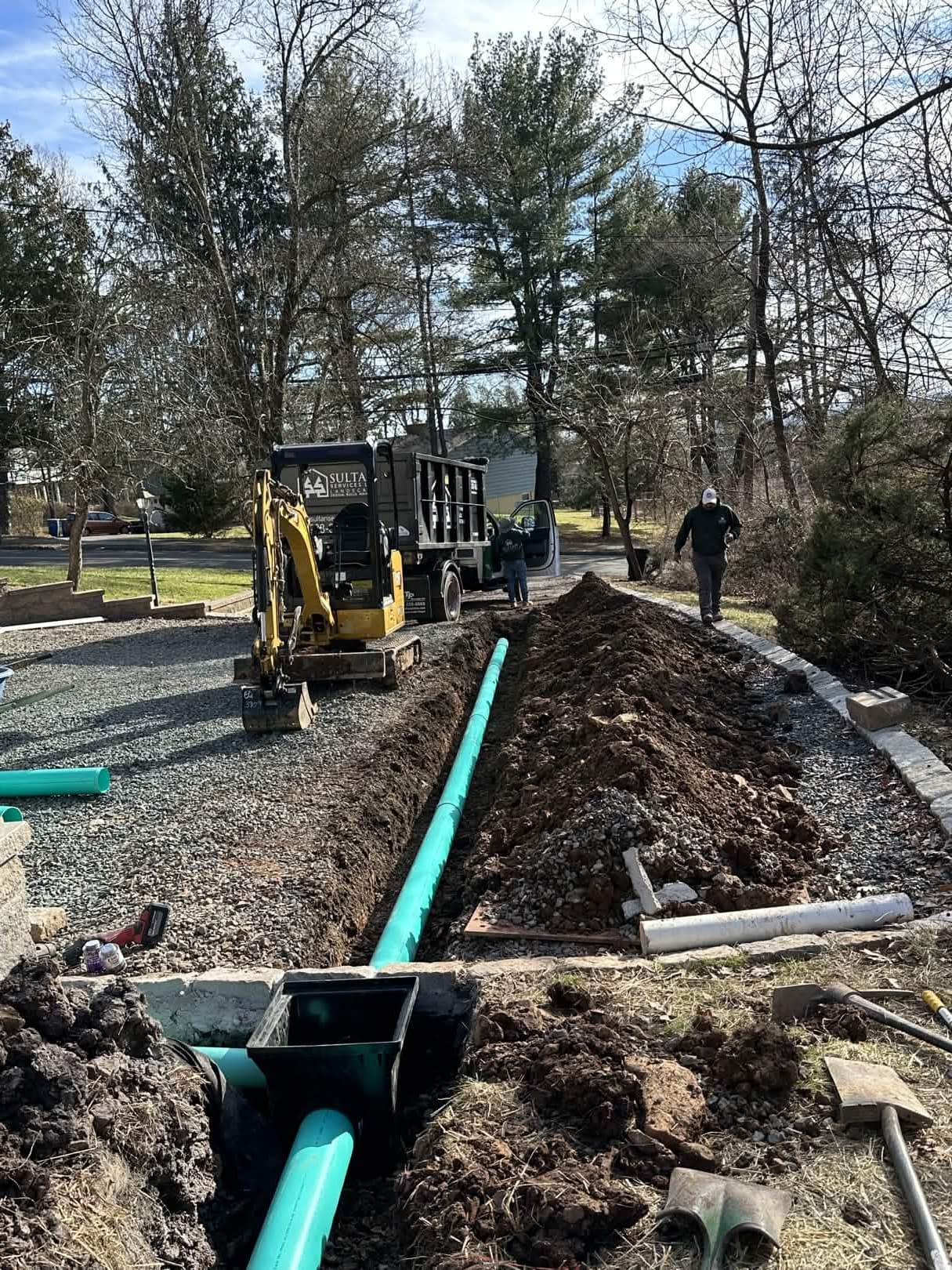
Common signs of drainage problems
Drainage problems rarely show up overnight. They develop over time as soil settles, grading shifts, drain lines clog, or downspouts dump water in the wrong place. Here are the most common signs that a property in Central New Jersey has a drainage issue:
- Water pooling in the yard after rain
- Wet or damp basement walls
- Erosion washing out planting beds
- Ice forming on walkways in winter from runoff
- Soggy or muddy areas that never fully dry
- Water running toward the foundation instead of away
- Gutter downspouts dumping water right next to the house
- Mold or mildew smell near the foundation
Why drainage problems are common in Central New Jersey
Somerset County, Hunterdon County, and the surrounding area have clay heavy soils that drain slowly. When it rains, the water sits near the surface instead of soaking in quickly. On flat or poorly graded lots, that water collects in low spots, against foundations, and in planting beds.
Properties near the Raritan River, Millstone River, Neshanic River, and their tributaries deal with higher water tables during wet seasons. Homes built on the Watchung ridges face different challenges — water runs fast down slopes and concentrates at the base, often right where the house sits.
Many homes in the area were built in the 1970s through 2000s, and the original grading has shifted over decades of settling, root growth, and landscaping changes. What drained fine when the house was new may not work anymore.
How drainage problems get fixed
The fix depends on where the water is coming from and where it needs to go. There is no one solution that works for every property. Common approaches include:
Regrading. If the ground slopes toward the house, the grade needs to be corrected so water flows away from the foundation. This is often the simplest fix if the problem is surface water.
French drains. A perforated pipe buried in a gravel trench collects subsurface water and routes it to a discharge point. French drains are the most common solution for wet yards and foundation water in Central New Jersey.
Downspout discharge lines. Gutters that dump water right at the foundation are a leading cause of basement moisture. Underground discharge lines route that water away from the house to a proper outlet.
Catch basins and dry wells. For properties where water collects in specific low spots, catch basins capture it and route it underground to a dry well or other outlet.
Swales. A shallow graded channel in the lawn can redirect surface water away from problem areas without the need for buried pipe.
Fixing it before building on top of it
If you are planning a patio, walkway, retaining wall, or landscape project, drainage should be evaluated before the build starts. A patio built on ground that does not drain properly will settle, pool water, and cause problems for the house. A retaining wall without drainage behind it will fail.
Solving the water first protects everything built on top of it. It is always cheaper to address drainage during construction than to tear something apart and fix it later.
Get your property evaluated
Sultan Services evaluates drainage problems and installs the right fix for properties across Hillsborough, Somerset County, and Central New Jersey. If you are seeing any of the signs listed above, call or send photos and we will walk the property with you.